What Is Pay-Per-Hire Recruitment?
Pay-per-hire recruitment emerged as a response toward long-standing inefficiencies within traditional hiring models. For decades, organisations relied upon retainers, resume volume commitments, or fixed agency fees disconnected from hiring success. These structures rewarded activity rather than outcomes, creating misalignment between recruiters and employers.
As hiring environments became more competitive and cost-sensitive, leadership teams began questioning predictable spend without predictable results. High attrition, offer drop-offs, and quality mismatch exposed weaknesses across conventional recruitment economics. Pay-per-hire introduced a simple premise: recruitment value crystallises only when a candidate successfully joins.
This model aligns commercial incentive with hiring success. Recruiters receive compensation only after role closure, encouraging focus upon relevance, intent validation, and joining confidence rather than pipeline inflation. Employers gain cost control, while recruiters assume execution accountability.
Pay-per-hire therefore represents not merely pricing innovation but a philosophical shift toward outcome-linked hiring partnerships.
How Pay-Per-Hire Differs From Traditional Agency Models
Traditional recruitment agencies operate through retainers, success fees, or hybrid arrangements. While these models provide predictability for agencies, they frequently disconnect recruiter effort from hiring outcome quality. Resume submissions often increase, while joining certainty remains uncertain.
Pay-per-hire recruitment restructures this equation. Payment triggers only after candidate onboarding confirmation, shifting financial risk toward recruiters. This naturally incentivises deeper screening, stronger intent validation, and tighter alignment with role expectations.
Unlike contingency hiring, pay-per-hire discourages superficial competition across agencies. Recruiters focus upon closure reliability rather than speed alone. Candidate engagement improves since recruiters invest energy only where joining probability remains high.
For employers, this model reduces wasted spend across unsuccessful mandates. Budget allocation aligns with actual workforce expansion rather than attempted hiring volume.
Core Mechanics Behind Pay-Per-Hire Recruitment
Pay-per-hire recruitment operates through clearly defined milestones. Role clarity, success criteria, and hiring timelines receive upfront alignment. Recruiters engage only after mutual agreement upon expectations, reducing ambiguity across delivery.
Candidate sourcing remains targeted rather than broad. Recruiters prioritise quality signals, cultural alignment, and availability confirmation early. Shortlists remain smaller yet more relevant.
Offer management plays a central role. Recruiters remain involved through negotiation, notice coordination, and joining assurance. Unlike traditional models, post-offer engagement carries equal importance as pre-offer sourcing.
This operational depth differentiates effective pay-per-hire execution from superficial fee rearrangement. Without structured process discipline, risk merely shifts without value creation.
Advantages For Employers Using Pay-Per-Hire
Employers adopting pay-per-hire recruitment gain immediate cost efficiency. Spend aligns directly with successful hires, improving financial predictability across scaling phases. Failed searches no longer drain budget.
Quality improvement emerges organically. Recruiters invest effort only where fit and intent align, reducing resume noise and interview fatigue. Hiring managers evaluate fewer candidates with higher relevance.
Time savings also compound. Reduced coordination overhead, fewer redundant interviews, and lower drop-off rates accelerate closure timelines without artificial pressure.
For leadership teams, pay-per-hire supports accountability. Recruitment partners share responsibility for hiring outcomes rather than task execution alone.
What Pay-Per-Hire Changes For Recruiters
Pay-per-hire fundamentally alters recruiter behaviour. Income correlates directly with hiring success, not activity volume. This encourages selectivity across mandates and discipline across execution.
Recruiters prioritise roles with clarity, responsive stakeholders, and realistic expectations. Poorly defined roles receive pushback or rejection, improving ecosystem quality.
Candidate relationships deepen. Recruiters invest more time validating intent, availability, and motivation, reducing late-stage fallout. Trust replaces transactional engagement.
This model rewards process maturity. Recruiters with strong screening frameworks, negotiation skill, and stakeholder management thrive. Others struggle under outcome pressure.
Risks And Misconceptions Around Pay-Per-Hire
Pay-per-hire does not guarantee hiring success automatically. Misconceptions arise when organisations expect unlimited effort without internal accountability. Role ambiguity, delayed feedback, and unrealistic compensation still derail outcomes.
Another risk involves recruiter over-filtering. Excessive conservatism may reduce candidate diversity or slow hiring velocity. Balance between quality and speed remains essential.
Sustainable pay-per-hire relationships require transparency, trust, and shared responsibility. Employers must engage actively, while recruiters must communicate constraints honestly.
Without process discipline, pay-per-hire becomes fragile rather than effective.
Measuring Success Within Pay-Per-Hire Hiring
Success measurement extends beyond joining confirmation. Quality metrics include retention, performance ramp, and hiring manager satisfaction.
Data transparency strengthens partnership health. Recruiters learn from outcomes, while employers refine requirement clarity and evaluation accuracy.
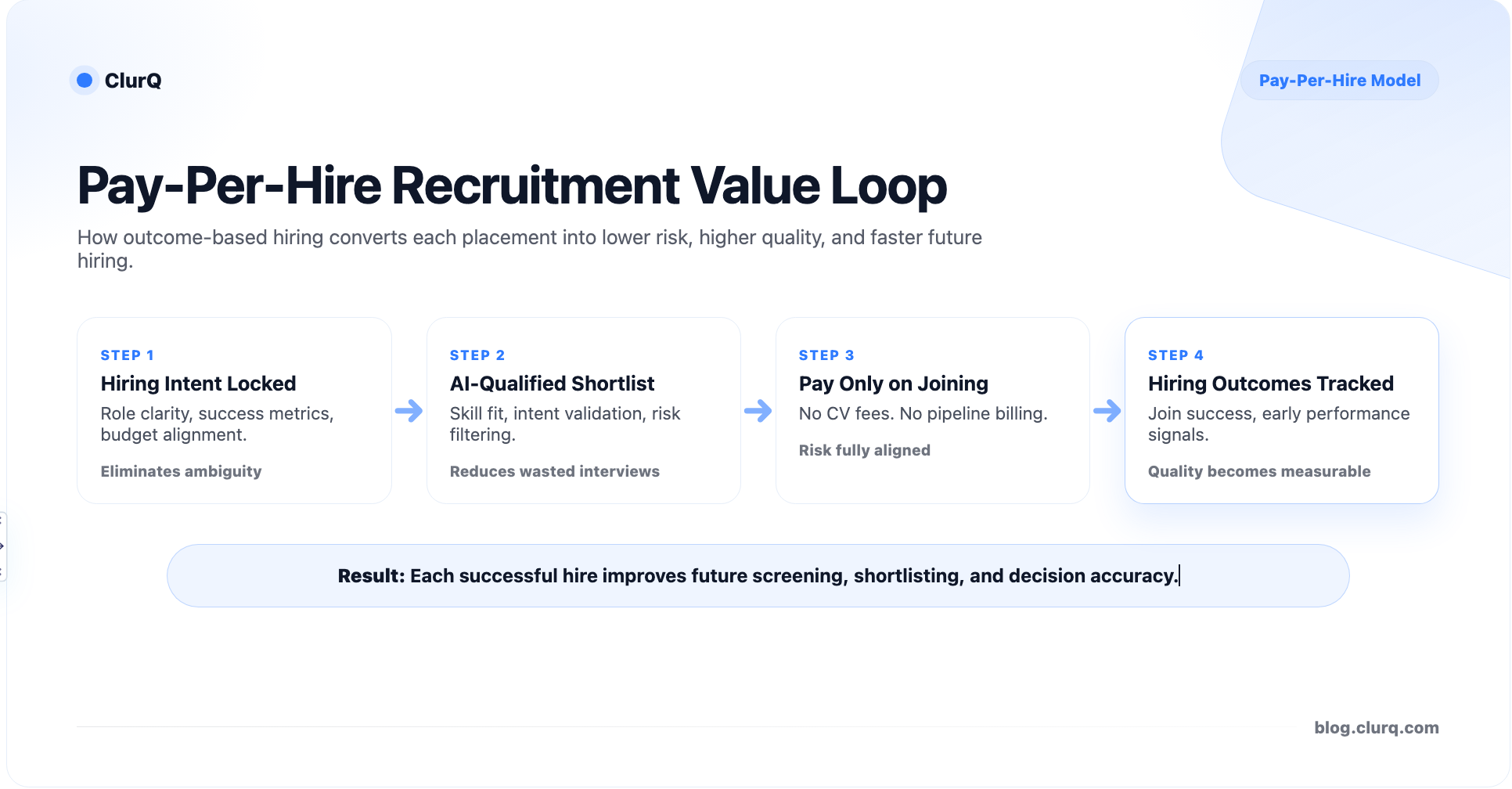
Role Clarity → Targeted Sourcing → Intent Validation → Offer Closure → Post-Hire Success
Measurement maturity elevates pay-per-hire from cost tactic toward strategic hiring model.
How Pay-Per-Hire Fits Modern Hiring Platforms
Technology enables pay-per-hire scalability. Workflow automation, candidate tracking, and offer visibility reduce coordination friction.
Shared dashboards improve trust across stakeholders. Progress, risks, and timelines remain visible, reducing dependency upon follow-ups and manual alignment.
This infrastructure transforms pay-per-hire into repeatable system rather than ad-hoc agreement, supporting consistency across multiple roles and teams.
Process transparency becomes the differentiator, not recruiter promises.
Pay-Per-Hire As Outcome-Driven Recruitment Future
Pay-per-hire recruitment reflects a broader shift toward accountability-led hiring. Employers demand results. Recruiters demand clarity. Alignment emerges through outcome-linked economics.
When executed correctly, this model reduces waste, improves trust, and elevates hiring quality across ecosystems. It rewards professionalism, discipline, and partnership rather than volume.
Pay-per-hire therefore represents future-ready recruitment, not discount hiring.